The Thing People Feel Before They Hear Your Words

Welcome back to your Peak of the Week, where we explore what it means to live aligned, lead authentically, and build a life that feels as good as it looks.
This Week →
Why smart people shrink or over-perform in key moments—and how both patterns cost you the same thing
The posture shift from self-protection to contribution that happens before you walk into the room
One micro-move to match your presence to the moment and the 3-minute review that makes it stick
Read Time < 3 minutes

Presence is the signal you send, and other people pick up that signal instantly.
WHAT I'M NOTICING
I was in a meeting a few weeks where someone in the room had a brilliant idea. Like, genuinely valuable. But they started with "This might be nothing, but..." and then apologized twice before they even got to the point.
The idea was amazing!!! But their presence collapsed the moment they started speaking.
I’ve seen this pattern on repeat as an executive recruiter. Smart, capable people shrinking themselves, not seeing or leaning into their value. Or the opposite….jumping in so fast, filling every gap, “proving themselves” instead of actually being present and curious.
Both patterns are confidence issues. Just opposite ends of the spectrum.
Presence isn't about your personality per se….it's not introversion or extroversion. It's not whether you're naturally charismatic or naturally quiet. Presence is the energy you bring into a room—the felt sense of you—and it happens before anyone processes your words.
I’m sure you’ve experienced this… You've felt someone walk into a room and immediately changes the temperature. Sometimes they calm the space. Sometimes they tighten it. Yep, that's presence. And it's shaped by confidence, whether you're matching the moment or missing it entirely.
WHAT IF?
What if the pattern keeping you stuck isn't about what you're saying, but about the posture you're holding when you say it?
When your presence collapses smaller than the moment needs, others miss your value. You had the insight, but you delivered it so apologetically that your audience didn’t take it seriously. Or, you held your idea back assuming the more senior people in the room should be the ones to speak.
And when your presence expands bigger than the moment needs, people tune out. You over-explained. You spoke with certainty when the room needed curiosity. You dominated the conversation when partnership would have built trust.
In both cases, nothing is wrong with your capability or your intelligence. It's just that your confidence didn't match the moment. And people decided how they felt about you based on your energy rather than what you were actually saying.
But guess what??? GOOD NEWS! You can shift all this.
What if instead of showing up in self-protection mode ("I don't want to sound stupid") or self-proving mode ("I need to show I'm prepared"), you could choose your posture before walking into the room?
Presence isn't something you perform. It's something you intentionally shape. And the shift starts with one simple practice: setting your intention.
MICRO-MOVES
This week, try this practice:
Before your next important conversation or meeting, take two minutes and answer these questions:
Spot your pattern. Do you tend to go smaller than the moment needs (apologizing, waiting for permission, shrinking your contribution)? Or do you tend to go bigger (jumping in fast, over-explaining, filling every silence)?
Choose your posture. If you go smaller, what would it look like to shift from self-protection into contribution? Maybe your new posture is: "Clarity is valuable even if it's not perfect" or "My perspective matters."
If you go bigger, what would it look like to shift from self-proving into partnership? Maybe your new posture is: "Curiosity builds trust faster than certainty" or "Slowing down gives my message power."
Pick one micro-move that supports that posture:
If you're working on going from smaller to contribution: Lead with a headline first. One clear sentence. No apologies, just the point.
If you're working on going from bigger to partnership: Ask one clarifying question before offering your view. "What matters most here?" Slow down by just 10%.
That's it. One posture. One micro-move.
Then after the meeting, take three minutes and reflect: Where did my presence match the moment? Where didn't it? Which micro-move would have shifted my presence?
This is my Four A’s process at work: Awareness, Attitude, Action, and Alignment. And when applied….this is how presence becomes sustainable.
What's your pattern? Do you tend to go smaller or bigger? And what posture are you practicing this week? How about someone on your team? What’s their pattern and might it be worth forwarding this email and let them know you want to work on this together?
Because we're building this awareness together.
When we know better, we do better.
Many of us are not aware of our patterns. Sometimes, it takes someone else helping see us and say something to crack us open.
Knowledge is power.
What’s your micro-move today?
With deep belief in your magnificence,
Laura
Want to work through this more deeply? I teach the full 4A's Framework (Awareness, Attitude, Action, Alignment) in my workshops that help your team elevate their impact—and the investment in how your people show up becomes the thing that drives your results. [Contact Us to Learn More]
↓
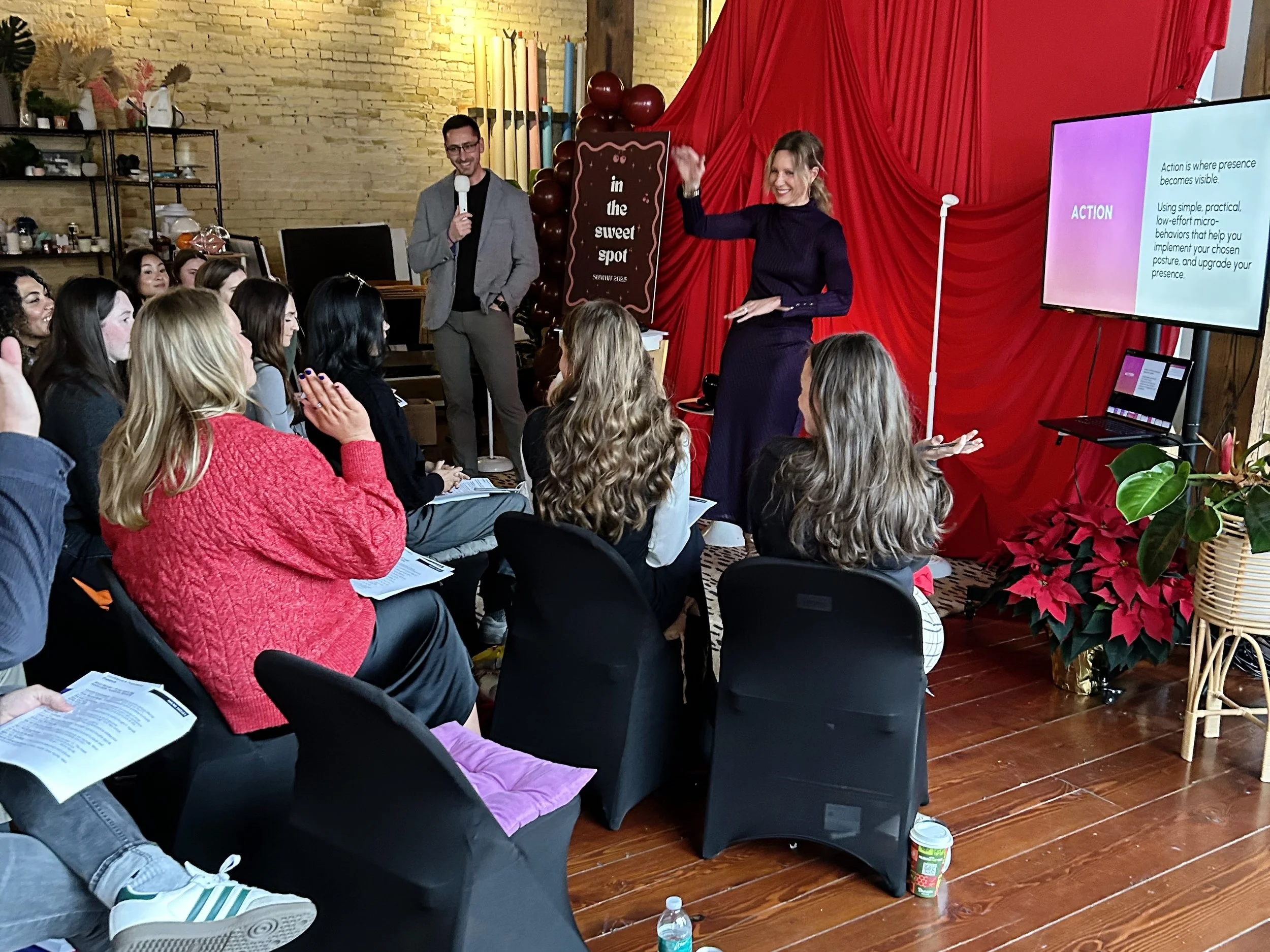
That’s exactly what we did at The Evoke Agency last week in Madison. Teaching their leaders and team members how to show up in front of clients with the kind of confident presence that delivers results. I love supporting organizations who know that when their people grow, the business grows. If your team is ready for this kind of lift, reply and lets talk!